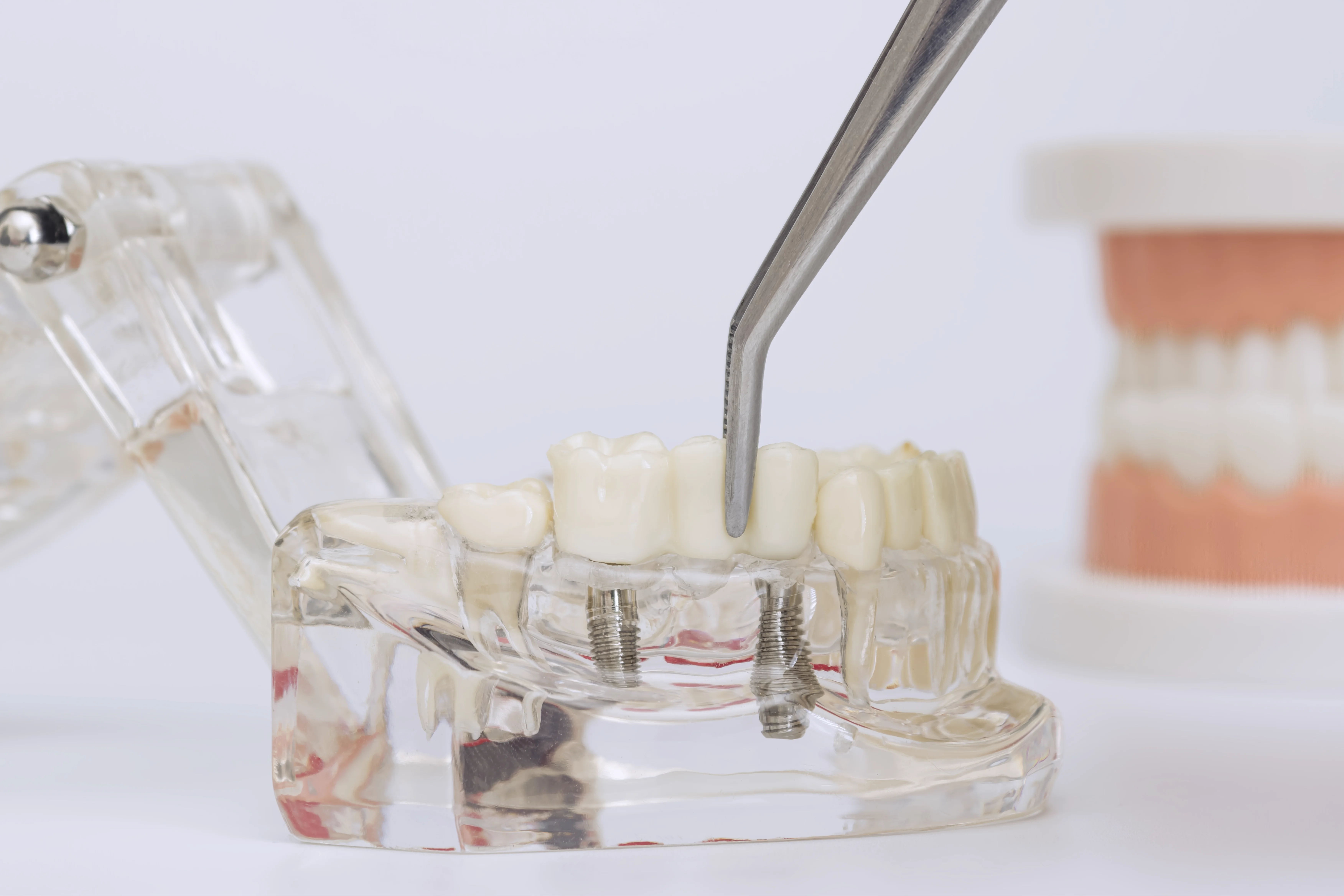
Dental implants
What is a dental implant?
A dental implant replaces the tooth's root and serves as a stable foundation for a new tooth.
A complete implant usually consists of three parts:
Implant fixture – a small screw of titanium or equivalent biocompatible material that is attached to the jawbone.
Abutment – connects the implant to the visible tooth.
Crown, bridge, or denture – the part you see when you smile and chew.
Implant treatment has been used in Sweden for several decades and is today an established and well-proven treatment method. With the right planning, materials, and follow-up, implants can last a very long time.
Why choose dental implants?
Dental implants are often the right option when you:
Are missing one or more teeth.
Have difficulty chewing with loose dentures.
Want to avoid grinding down healthy teeth for a bridge.
Want a solution that feels stable, natural, and aesthetically pleasing
Advantages
Stability – anchored in the jawbone.
Natural feel – feels close to a natural tooth.
Preserves jawbone – the load stimulates the bone and can slow bone loss.
High comfort – no sticky dentures, no loose parts.
Dental implant cost – what affects the price?
It's impossible to give an exact price without examination, but there are clear factors that sway the cost:
How many teeth are to be replaced.
If pre-treatment is needed (tooth extraction, bone augmentation, treatment of periodontitis).
Choice of material and construction.
If treatment is carried out under sedation or anesthesia.
The clinic and the practitioner's experience.
With us, the price for a single implant (fixture + crown) often ranges from about 20,000–30,000 before high-cost protection, but it varies significantly and should always be based on a personal assessment. The actual cost is also affected by state dental support and high-cost protection.
Important for the patient:
Always ask for a clear written treatment plan with a cost range.
Ensure the clinic is affiliated with Försäkringskassan.
Don't just compare prices – look at experience, material, follow-up, and approach.
At Luxadent, we focus on transparency: price, options, and dental support are explained before you decide, so that dental implants become a considered investment – not a surprise.
Dental implant pain – does it hurt?
During the procedure:
The implant is inserted under local anesthesia. Most people feel pressure and vibrations, but not sharp pain.
Afterwards:
It is common to experience:
Tenderness
Swelling
Some pain during the first few days
This is usually effectively managed with regular pain relievers according to the dentist's recommendation. Most describe the discomfort as milder than expected and much more manageable than they thought beforehand.
When should you contact the clinic immediately?
Severe pain that does not subside.
Fever or increasing swelling.
Bleeding that does not stop.
Clear information, thorough instructions, and follow-up reduce anxiety and make the experience safer.
How does the implant treatment work – step by step
1. Consultation and examination
At the first visit:
You review your wishes, health, and expectations.
Clinical examination and X-rays are performed
Bone quantity, bite, oral hygiene, and any risk factors are assessed.
You receive a treatment plan proposal and a cost estimate.
2. Pre-treatment if needed
Before the implant is placed, certain measures may be necessary:
Removal of damaged or infected teeth.
Treatment of periodontitis or inflammation.
Bone augmentation or sinus lift if bone volume is insufficient.
All of this is done to give the implant the best possible conditions.
3. Surgery – when the implant is placed
The treatment is carried out under local anesthesia.
The dentist exposes the bone and attaches the implant fixture to the jawbone.
The wound is stitched up and the implant is allowed to integrate into the bone (osseointegration).
For larger procedures or pronounced dental anxiety, sedation or anesthesia may be an option, depending on the clinic's offerings.
4. Healing period
The healing time is usually about 2–3 months, sometimes longer depending on the initial situation. In the meantime, you can often have a temporary solution for aesthetics.
5. Digital scanning and preparation of the teeth
When the implant is stable:
Digital scanning or impressions are taken.
A dental technician creates an individually tailored crown, bridge, or denture.
Color and shape are customized to match your other teeth and smile.
Dental implant risks – what do you need to know?
All surgical interventions involve risks. However, in the case of implants, the risks are very small.
A safe implant treatment is based on:
Thorough pre-investigation.
Correct patient selection.
Experienced surgeon/prosthodontist.
Clear instructions and regular checks.
You are in safe hands when you choose Luxadent.
Are dental implants suitable for everyone?
Short answer: no, but for many.
You can often get dental implants if:
You are healthy or well-controlled with your diseases.
You have enough bone or can build up the bone.
You can maintain your oral hygiene carefully.
You do not smoke or are willing to quit in connection with the treatment.
In some cases, other solutions are recommended, such as bridges or dentures. The important thing is that the treatment is adapted to your reality – not the other way around.
How long do dental implants last?
With good oral hygiene, regular check-ups, and well-executed treatment, dental implants can last a very long time. There are patients who have had functioning implants for several decades. No reputable clinic promises a “lifetime guarantee” without conditions, but the goal is always a long-term solution.
How to care for your implants
Brush teeth and implants thoroughly morning and evening.
Use interdental brushes / dental floss around the implants.
Attend regular check-ups and professional cleaning.
Follow the clinic's advice on smoking cessation, cleaning routines, and follow-up.
An implant requires as much care as a natural tooth.
Why choose Luxadent for dental implants?
Experience in advanced implant treatment.
Focus on safety, clear communication, and realistic expectations.
Modern technology, digital impressions, and quality materials.
Individual treatment plans where function, aesthetics, and long-term prospects outweigh the fastest or cheapest solution.
Options for anxious patients, such as sedative treatment or sleep treatment (anesthesia).